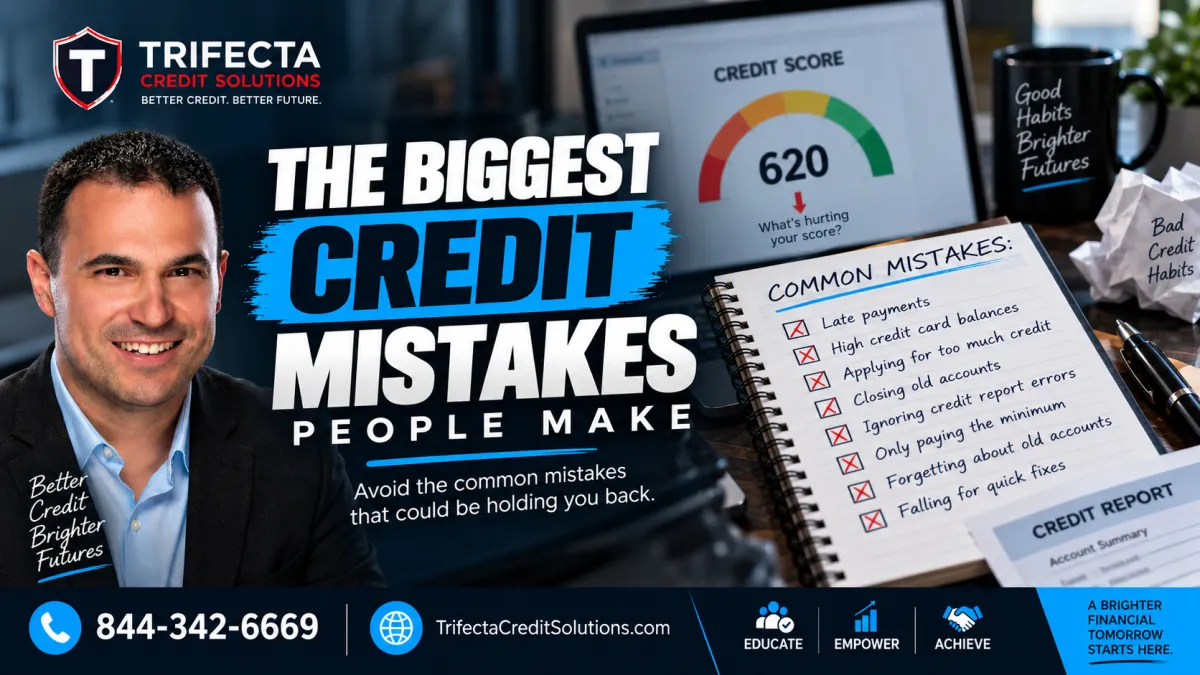
The Biggest Credit Mistakes People Make
The Biggest Credit Mistakes People Make
Most people don't intentionally damage their credit.
It usually happens through small decisions that add up over time.
A forgotten payment. A credit card balance that keeps growing. Applying for several accounts at once. Ignoring a credit report because everything seems fine.
One mistake may not destroy your financial future, but repeated mistakes can make reaching your goals more difficult.
Here are some of the biggest credit mistakes people make—and what you can do differently.
1. Missing Payments
This is one of the most important mistakes to avoid.
Payment history is an important factor in commonly used credit-scoring models. Once an account becomes sufficiently past due and is reported, it can negatively affect your credit profile.
Sometimes missed payments aren't caused by financial hardship.
They're simply forgotten.
An old card may still have a subscription attached to it. A bill may go to an old email address. Autopay may stop working.
Consider setting reminders or automatic payments where appropriate, and continue checking your accounts even when autopay is enabled.
2. Letting Credit Card Balances Get Too High
Your credit limit isn't a spending target.
If you have a $10,000 limit, that doesn't mean carrying a $9,000 balance is a good idea.
Credit utilization measures how much revolving credit you're using compared with your available limits.
For example:
$1,000 balance ÷ $10,000 limit = 10% utilization
$8,000 balance ÷ $10,000 limit = 80% utilization
Higher utilization can negatively affect credit scores.
The CFPB recommends keeping your use of available credit low rather than getting close to your limits. CFPB guidance on building and maintaining good credit
3. Thinking 30% Utilization Is the Goal
You've probably heard:
“Keep your utilization at 30%.”
That doesn't mean you should intentionally maintain a 30% balance.
Thirty percent is commonly discussed as a guideline, not a target you need to reach.
If your utilization is already lower, there's generally no reason to spend more just to hit 30%.
Lower revolving balances can generally be better than consistently using a large portion of your available credit.
4. Applying for Too Much Credit at Once
Every attractive credit card offer doesn't need an application.
When you apply for financing, a lender may perform a hard inquiry.
Opening several accounts in a short period can also change the overall characteristics of your credit profile.
This doesn't mean you should be afraid to apply for credit.
It means you should apply strategically.
Before applying, ask yourself:
Do I actually need this account?
5. Closing Old Credit Cards Without Thinking
You finally pay off a credit card and immediately close it.
That may feel responsible—but consider the bigger picture first.
Suppose you have:
Card A: $5,000 limit
Card B: $5,000 limit
Current balances: $2,000
With both cards open, you have $10,000 of available revolving credit and 20% overall utilization.
If you close one $5,000 card while still carrying $2,000, your available revolving credit falls to $5,000.
Your utilization could rise to 40%.
Closing an account may still make sense in some circumstances, such as avoiding an annual fee or managing overspending.
Just don't assume closing a card automatically improves your credit.
6. Forgetting About Old Accounts
That old store card sitting in a drawer can still matter.
Imagine you opened a card years ago to receive a discount.
You stopped using it.
Then a small recurring charge appears.
You don't notice.
The payment becomes late.
A forgotten account can suddenly become a credit problem.
Keep a list of your open accounts and review them regularly.
7. Only Watching Your Credit Score
People check their score constantly but sometimes never review the information behind it.
Your score is only part of the picture.
Your credit reports contain the underlying account information that may help explain why your score changed.
Review your reports for things such as:
Incorrect balances
Unfamiliar accounts
Incorrect late payments
Duplicate information
Incorrect account status
Other potential inaccuracies
You can obtain free credit reports through the federally authorized source, AnnualCreditReport.com.
8. Ignoring Credit Report Errors
If something on your credit report looks wrong, don't automatically assume it will correct itself.
Investigate it.
Federal law gives consumers the right to dispute inaccurate or incomplete information on their credit reports.
The CFPB explains how to dispute errors with credit reporting companies and the businesses that provided the information. CFPB credit-report dispute guidance
Only dispute information you genuinely believe is inaccurate or incomplete.
9. Carrying a Balance Because You Think It Builds Credit
This is a persistent credit myth.
You do not need to carry credit card debt from month to month and pay interest simply to prove that you can use credit.
Using credit responsibly and paying according to your account terms can establish payment activity without intentionally carrying unnecessary debt.
Don't pay interest just because someone told you it's required to build credit.
10. Making Only the Minimum Payment Forever
Making at least the required payment on time is important.
But if you consistently carry large revolving balances while making only minimum payments, your debt can become expensive and may take a long time to repay.
When your budget allows, reducing balances more aggressively can help lower your debt and revolving utilization.
11. Co-Signing Without Understanding the Risk
Helping someone qualify for financing may feel generous.
But co-signing isn't simply giving someone a reference.
You're taking on financial responsibility.
If the borrower fails to make required payments, the consequences may affect you as well.
Before co-signing anything, understand exactly what you're agreeing to.
12. Waiting Until You Need a Loan to Work on Your Credit
This mistake can be especially frustrating.
You find the house.
You need a vehicle.
Your business needs financing.
Then you check your credit.
Preparing earlier gives you more time to understand your reports, address legitimate inaccuracies, reduce debt, and establish stronger financial habits.
The best time to prepare for financing is often before you urgently need it.
13. Falling for “Instant Credit Fix” Promises
Be careful with anyone promising:
“Guaranteed 100-point increase!”
“Perfect credit in 30 days!”
“We can erase everything negative!”
There is no legitimate strategy that can guarantee a specific credit-score increase for everyone.
Accurate negative information generally cannot simply be removed because you don't like it.
Legitimate credit improvement focuses on understanding your reports, correcting genuine inaccuracies, managing debt responsibly, and building healthier financial habits.
14. Treating Better Credit as Permission to Spend More
Improving your credit can potentially give you access to more financing.
That doesn't mean you need to use it.
A $20,000 credit limit isn't $20,000 of additional income.
A large loan approval doesn't necessarily mean the payment comfortably fits your budget.
Better credit should create options—not unnecessary debt.
15. Fixing the Past Without Changing the Habits
This may be the biggest mistake of all.
You can address problems from your past, but if the same financial habits continue, new problems can appear.
Long-term credit health requires consistency.
That means:
Paying bills on time
Monitoring your accounts
Keeping balances manageable
Reviewing your credit reports
Borrowing strategically
Avoiding unnecessary applications
Maintaining a realistic budget
Credit improvement isn't just about fixing yesterday. It's about changing what happens tomorrow.
Better Credit Starts With Better Decisions
You don't need perfect credit.
And you don't need complicated “credit hacks.”
Start with the fundamentals.
Pay on time.
Watch your balances.
Review your reports.
Don't borrow unnecessarily.
Question information that appears inaccurate.
Prepare before you need financing.
Small improvements repeated consistently can help create a stronger financial foundation.
Are Credit Mistakes Holding You Back?
Maybe you're preparing to buy a home.
Maybe you're looking for business funding.
Maybe you simply want to understand why your credit isn't where you'd like it to be.
The first step is identifying what's actually happening.
Trifecta Credit Solutions can help you better understand your credit profile, identify potential areas that need attention, and develop a strategy based on your financial goals.
Call Trifecta Credit Solutions at 844-342-6669 to schedule your FREE credit consultation today.
Better Credit. Brighter Futures.

